



"Global Histories" Lecture Series
“Global Histories” is a lecture series held several times a year at the Faculty of Theology, Martin Luther University Halle-Wittenberg. The lectures are conducted in either English or German and are conveyed by the Chair of Religious Studies/Intercultural Theology and the Chair of Global History of Christianity and Orthodox Christian Studies.
Why “Global Histories”? In the context of this series, history is understood not as something distant or antiquated. Instead, history is seen as a string of specific contingent events situated in time and space, interpreted and conveyed through historiography. Historiography, in turn, is viewed as a function of the present, shaped by its categories, topics, and modes of representation. The title “Global Histories” reflects the multiplicity of contexts and perspectives, each rooted in local conditions yet interconnected through global entanglements.
The thematic focus of the series is shaped by the academic expertise of its organizers. “Global Histories: Lectures on Christianity and Religions” is further enriched by the complementary and innovative series “Perspectives on Christianity and Religions.” Together, these initiatives foster dialogue around dominant narratives and counter-narratives.
For further information, please contact the organizers, Prof. Dr. Daniel Cyranka and Jun.-Prof. Dr. Stanislau Paulau.
Winter semester 2026/27

Lectures by Prof. Dr. Daniel König and Prof. Dr. Claudia Hoffmann
Prof. Dr. Daniel G. König (München)
"Islam" and "the West" in Transmediterranean Memory Culture. On the Intertia of Geocultural Categories
November 19th 2026 6:15 p.m. HS II
Geocultural categories associate a geographical area with a specific “culture,” which is assumed to display particular traits. As geocultural categories, “Islam” and “the West” evoke images of two distinct spheres with a long and complex historical relationship. However, instead of regarding themselves as a geocultural unit, societies north and south of the Mediterranean continue to emphasise their own victimisation at the hands of “the Other.” At the same time, they engage in forms of asymmetric exchange characterised by largely unidirectional flows of agricultural products, gas and oil, tourists, and migrants, while casting increasingly anxious glances towards the USA, Russia, and China. The paper will not analyse the activities of FRONTEX, national and supra-national actors, or the geopolitical challenges of our time. Instead, it will focus on the question of why the perception of separation remains stronger than the awareness of shared historical heritage. From the perspective of a cultural historian interested in the longue durée, the paper examines transmediterranean memory culture, i.e. the ways in which societies across the Mediterranean deal with, commemorate, represent and debate their shared past. This dimension should not to be neglected, given that perceptions of the past clearly contribute to the way in which societies forge their future.
Prof. Dr. Claudia Hoffmann (Heidelberg)
Mission? A Global Term in Interreligious Contact Zones
Januar 14th 2027 6:15 p.m. HS II
This lecture examines how the contested term "mission" is negotiated in interreligious contact zones. Drawing on ethnographic fieldwork, it traces how Christian and Muslim actors use, avoid, and reinterpret a concept burdened by colonial history yet still central to Christian self-understanding. Rather than treating “mission” as a fixed theological category, the talk approaches it as a contact zone term: a concept whose meaning is negotiated locally. The analysis identifies three dimensions in which mission surfaces in practice: personal witness, practical love, and self-promotion. Contrary to expectations, the lecture argues that even an exclusivist missionary stance can foster (rather than foreclose) pluralistic engagement: across all four contexts, where empirical research was conducted, both Christian and Muslim interlocutors come to understand mission not as proselytizing in the narrow sense, but as relationship-building, public confession, and boundary-crossing, practices that resist confining religion to the private sphere. The case illuminates how religious communities function as interreligious contact zones and offers an empirical counterpoint to theological and historical debates on mission, diversity, and dialogue in global Christianity.
Summer Semester 2025

GLOBAL HISTORIES: Frieder Ludwig 14/7/2026
On July 14th 2026, Prof. Dr. Dr. Frieder Ludwig (Stavanger) will present within the series „Global Histories. Lectures on Christianity and Religions”, discussing the topic "Missionswissenschaft? Zur Genese einer akademischen Disziplin im 20. Jahrhundert".

Lecture by Sophie Zviadadze
On June 4th 2026, Prof. Dr. Sophie Zviadadze (Tblisi/Georgia) will present within the series „Global Histories. Perspectives on Christianity and Religions”, discussing the topic"Ein Gott und zwei Himmel: Zum Muslimischsein im 'christlichen' Georgien".
Winter Semester 2025/26
Lecture by Prof. Dr. Jörg Haustein
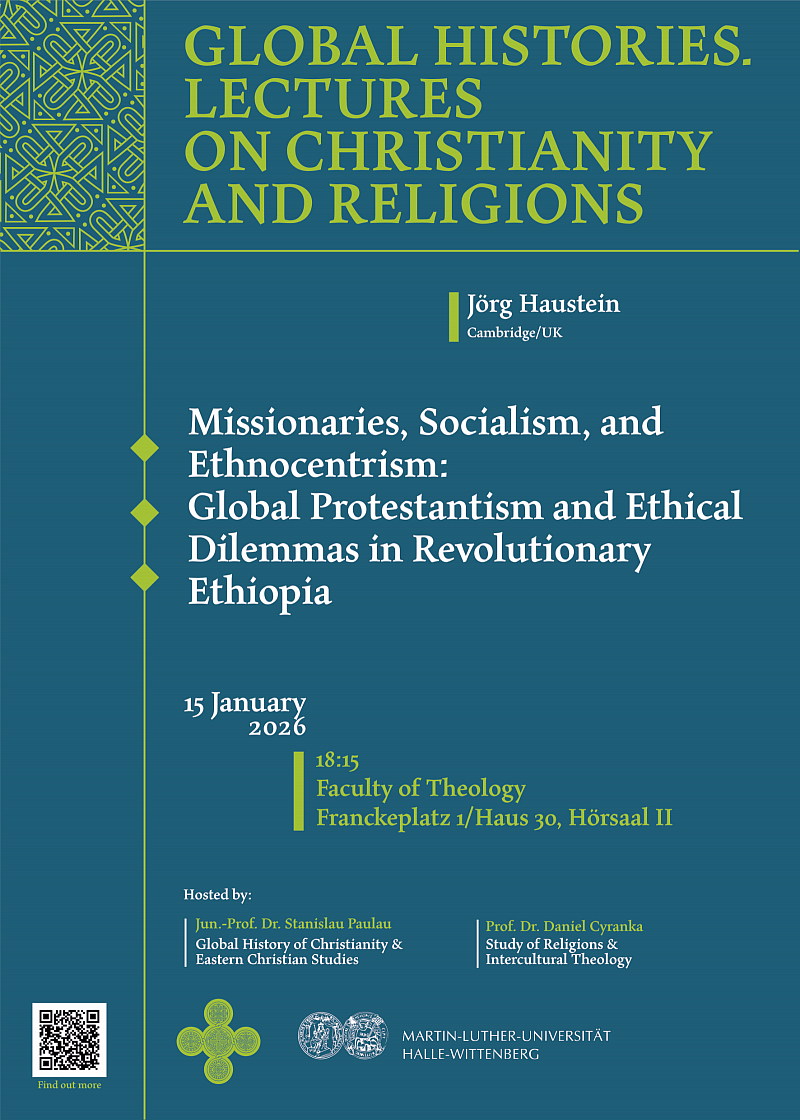
On January 15th 2026, Prof. Dr. Jörg Haustein (Cambridge/UK) will present within the series „Global Histories. Lectures on Christianity and Religions”, discussing the topic "Missionaries, Socialism, and Ethnocentrism: Global Protestantism and Ethical Dilemmas in Revolutionary Ethiopia".
This lecture studies how Cold War-era Protestant mission work became entangled with revolutionary politics and ethnonationalist movements in Africa. Focusing on the theologian, scholar of Islam, missionary, and political campaigner Gunnar Hasselblatt (1928–1997), the lecture traces transnational flows between Socialist Ethiopia and West Berlin, carving out the ethical disputes arising in this arena. After the 1979 murder of Gudina Tumsa, the general secretary of the Ethiopian Mekane Yesus Church, Hasselblatt’s advocacy for the Oromo liberation struggle led to a rift between the Berlin Mission and the Ethiopian church centring on ethnonationalism, co-operation with socialist governments, and the nature of church partnerships. The case illuminates broader transformations in 20th-century global Christianity while documenting how East-West German anxieties about church and socialism became inseparable from Ethiopian revolutionary debates.
Global Histories. Perspectives on Christianity and Religions WiSe 2025/26
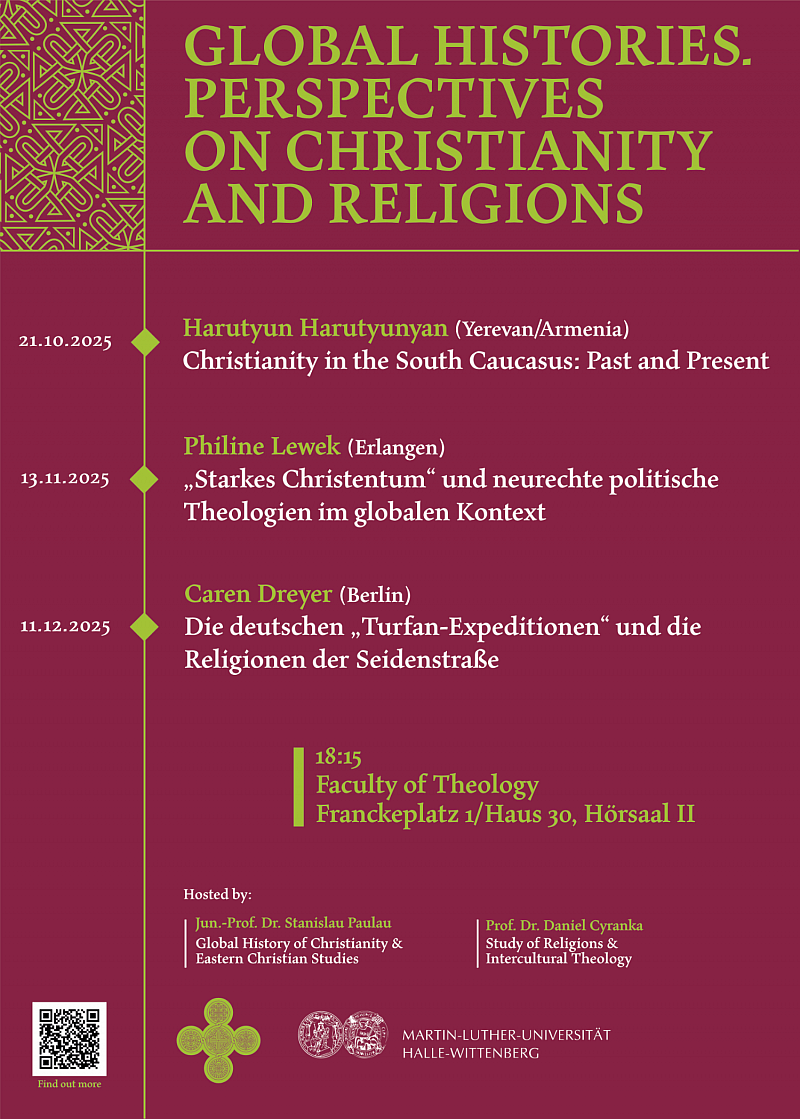
On Octobre 21st 2025, Prof. Dr. Harutyun Harutyunyan (Jerewan/Armenien) will present within the series „Global Histories. Perspectives on Christianity and Religions”, discussing the topic "Christianity in the South Caucasus: Past and Present".
On Novembre 11th 2025, Dr. Philine Lewek (Erlangen) will present within the series „Global Histories. Perspectives on Christianity and Religions”, discussing the topic "'Starkes Christentum' und neurechte polistische Theologien im globalen Kontext".
On Decembre 12th 2025, Dr. Caren Dreyer (Berlin) will present within the series „Global Histories. Perspectives on Christianity and Religions”, discussing the topic "Die deutschen 'Turfan-Expeditionen' und die Religionen der Seidenstraße".
Summer Semester 2025
Presentation by Prof. Giovanni Maltese
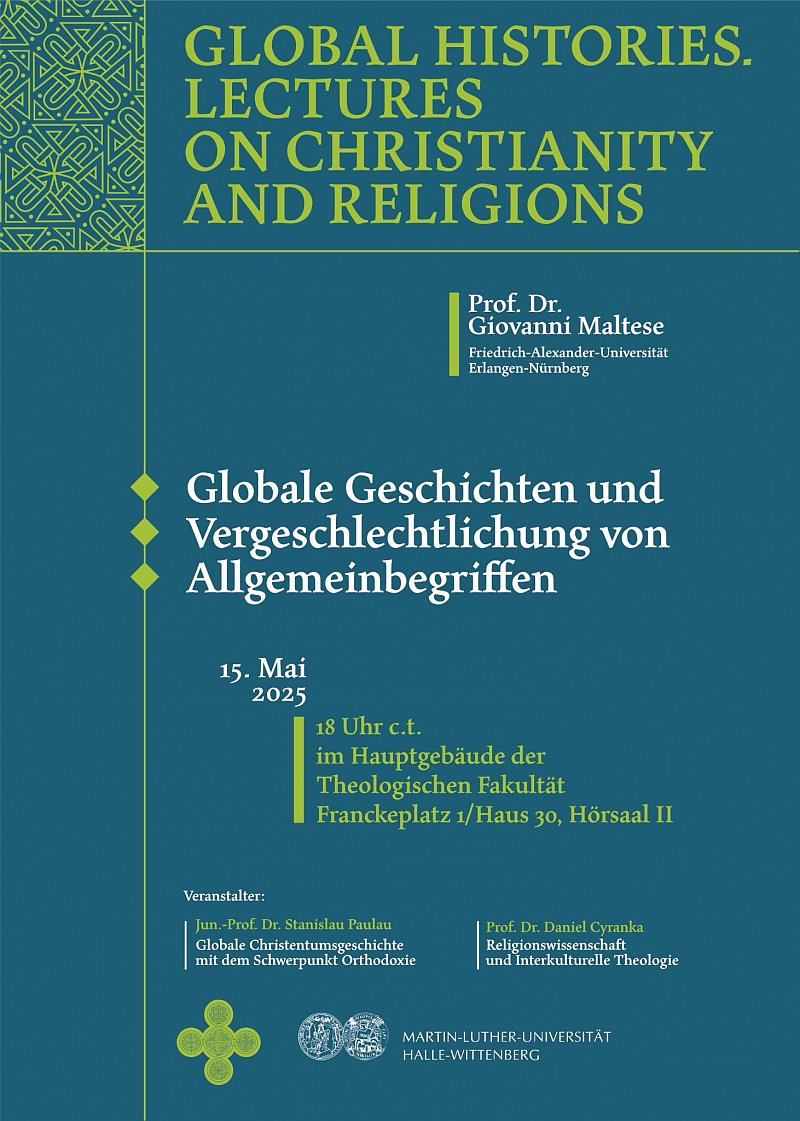
On May 15th 2025, Prof. Dr. Giovanni Maltese (Friedrich-Alexander-Universität Erlangen-Nürnberg) presented within the series „Global Histories. Lectures on Christianity and Religions”, discussing the topic "Globale Geschichten und Vergeschlechtlichung von Allgemeinbegriffen".
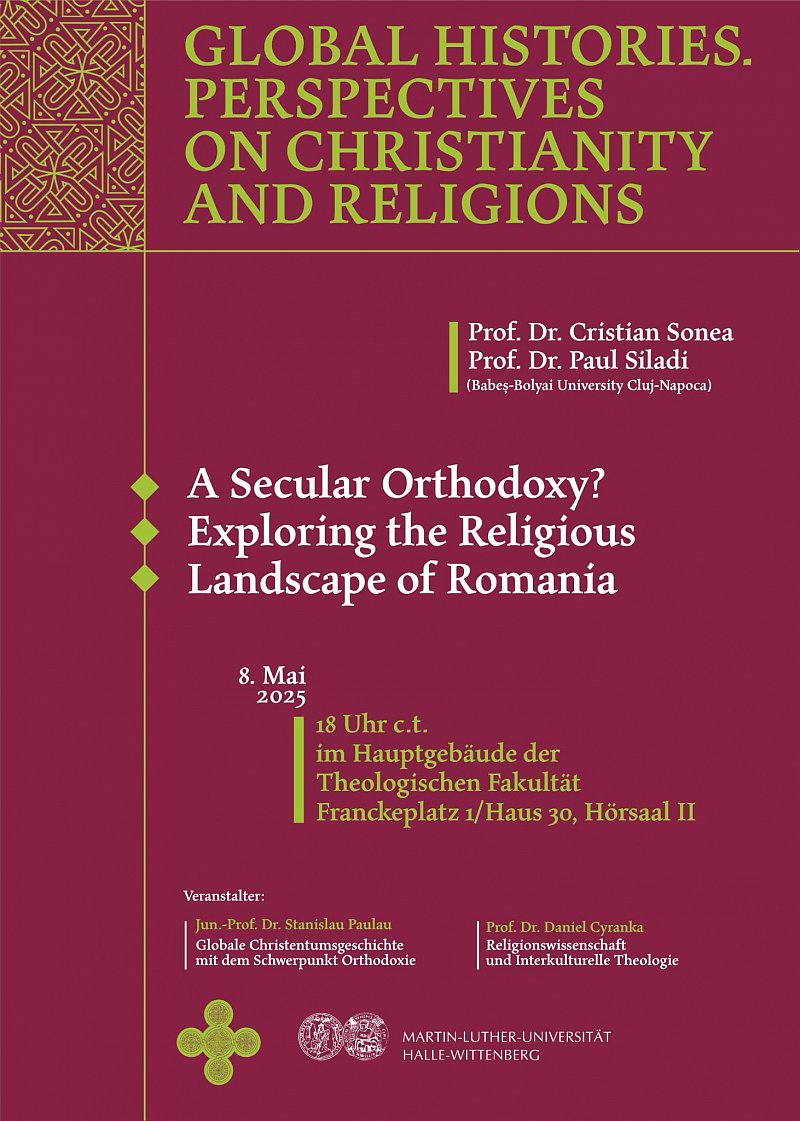
Presentation by Prof. Cristian Sonea and Prof. Paul Siladi
On May 8th 2025, Prof. Dr. Cristian Sonea and Prof. Dr. Paul Siladi (Babes-Bolyai-University Cluj-Napoca) presented within the series „Global Histories. Perspectives on Christianity and Religions”, discussing the topic "A Secular Orthodoxy? Exploring the Religious Landscape of Romania".
The lecture critically examines the complex phenomenon of secularisation within Orthodox communities in Romania, reassessing prevailing narratives of religious decline or revival. Drawing on interdisciplinary perspectives from theology, sociology, and history, the lecture investigates both external expressions—such as public religious symbolism, state funding, and church construction—and internal dynamics, including ritualism and spiritual disengagement. It reveals the paradoxical coexistence of overt religiosity and underlying secular tendencies, addressing phenomena like nationalist religiosity, compensatory practices, and the Church’s secular legitimization. The lecture argues that Romanian secularisation is not a mere import of Western paradigms and proposes a renewed eschatological and liturgical orientation as a way for Orthodox communities to engage with modernity while preserving their spiritual integrity.
Winter Semester 2024/2025
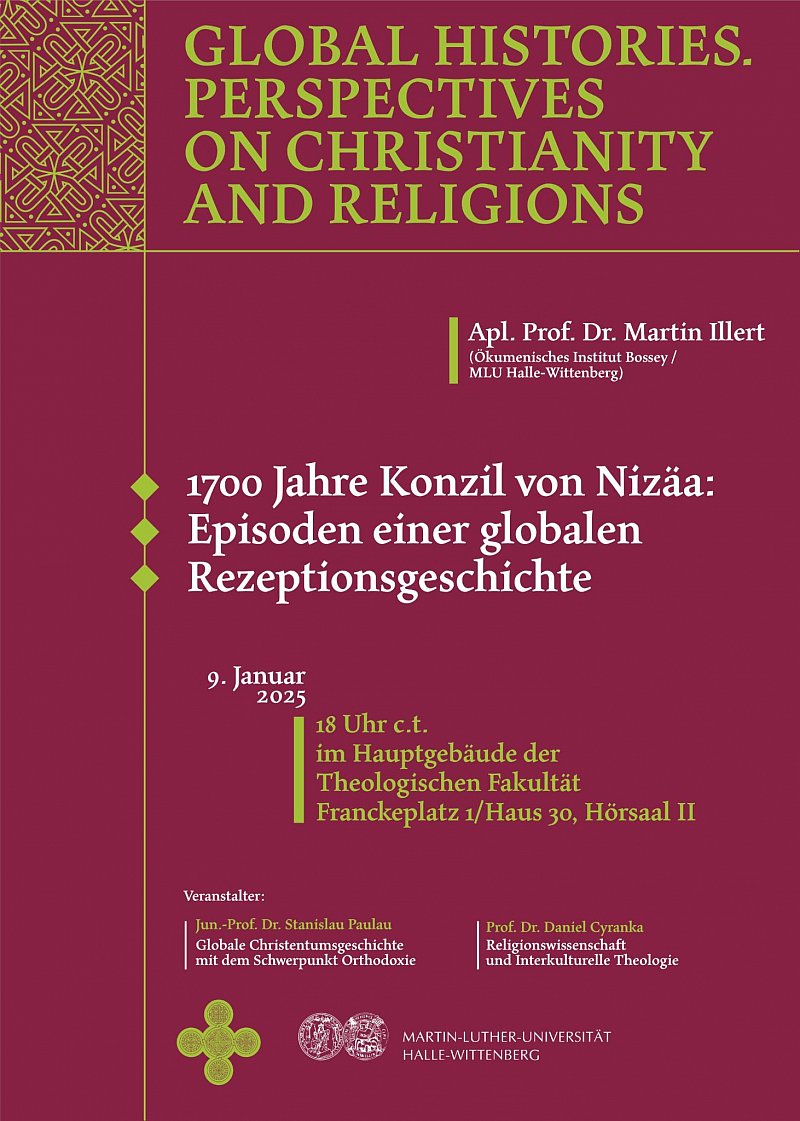
Presentation by Prof. Martin Illert
On January 9th 2025, Prof. Dr. Martin Illert presented within the series „Global Histories. Perspectives on Christianity and Religions”, discussing the topic "1.700 Jahre Konzil von Nizäa: Episoden einer globalen Rezeptionsgeschichte".
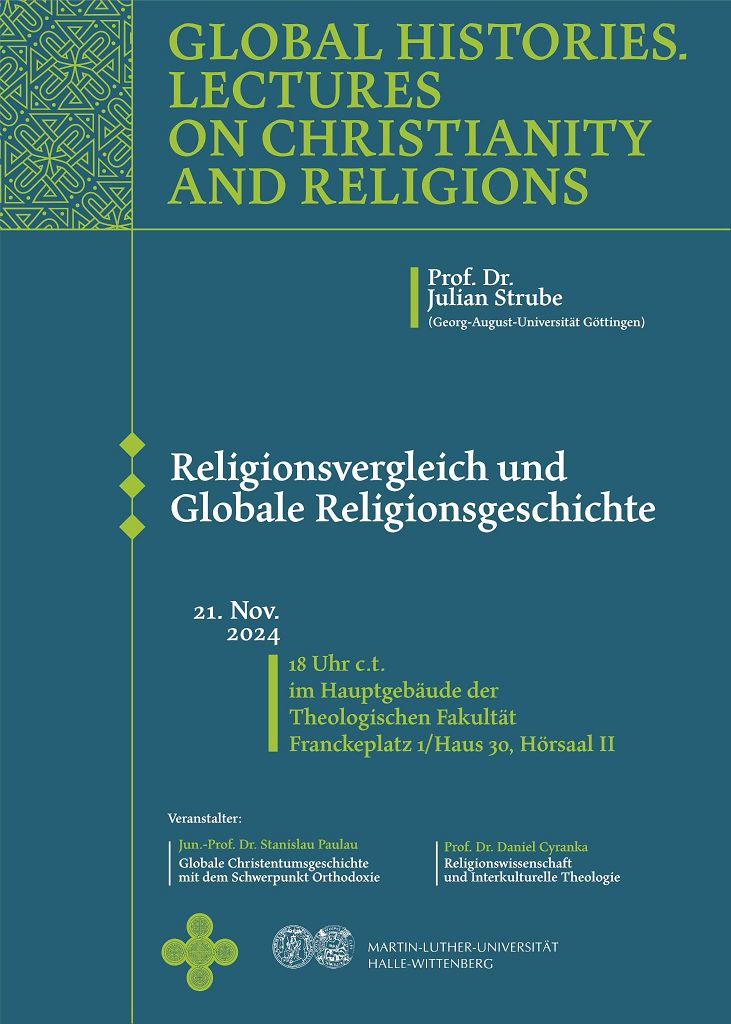
Presentation by Prof. Julian Strube
On November 21st 2025, Prof. Dr. Julian Strube (Georg-August-Universität Göttingen) presented within the series „Global Histories. Lectures on Christianity and Religions”, discussing the topic "Religionsvergleich und Globale Religionsgeschichte".
Summer Semester 2024
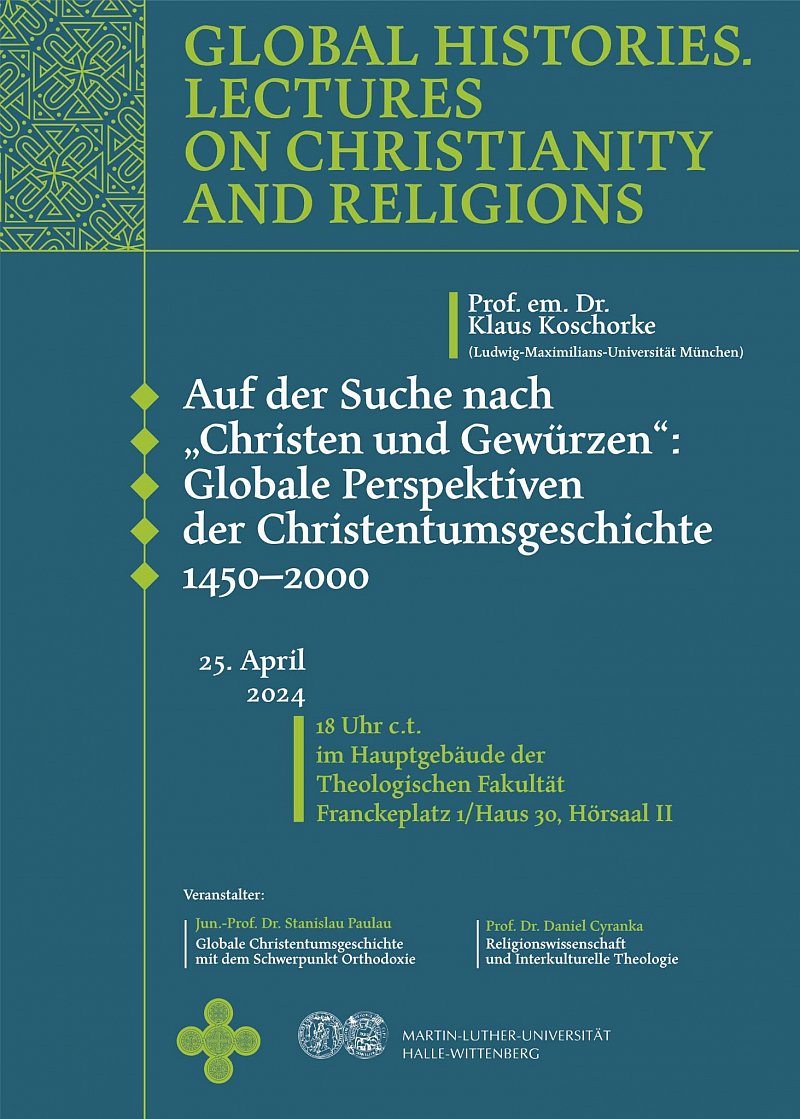
Presentation by Prof. Klaus Koschorke
On April 25th 2025, Prof. em. Dr. Klaus Koschorke (Ludwig-Maximilians-Universität München) presented within the series „Global Histories. Lectures on Christianity and Religions”, discussing the topic "Auf der Suche nach 'Christen und Gewürzen': Globale Perspektiven der Christentumsgeschichte 1450–2000".